Comprehensive Bardeen.ai Review (2026): Next-Gen Operational Scaling
Every modern revenue, ops, and research team is quietly suffocating under the same invisible tax: hundreds of micro-tasks performed by hand inside a browser tab. Copying a LinkedIn profile into a CRM. Pasting a directory of vendors into a spreadsheet. Re-checking a pricing page for a change. Re-triggering the same five-step follow-up sequence. Bardeen.ai attacks that tax at the source — not with another dashboard to learn, but with an automation layer that lives inside the browser you already have open, turning repetitive clicks into one-click playbooks and AI agents that run while you do higher-value work.
🚀 Core Products & Services in Bardeen.ai
Bardeen.ai delivers a unified ecosystem of AI-powered solutions designed to accelerate deliverable turnaround with enterprise reliability:
1. Bardeen Browser Extension & Automation Engine
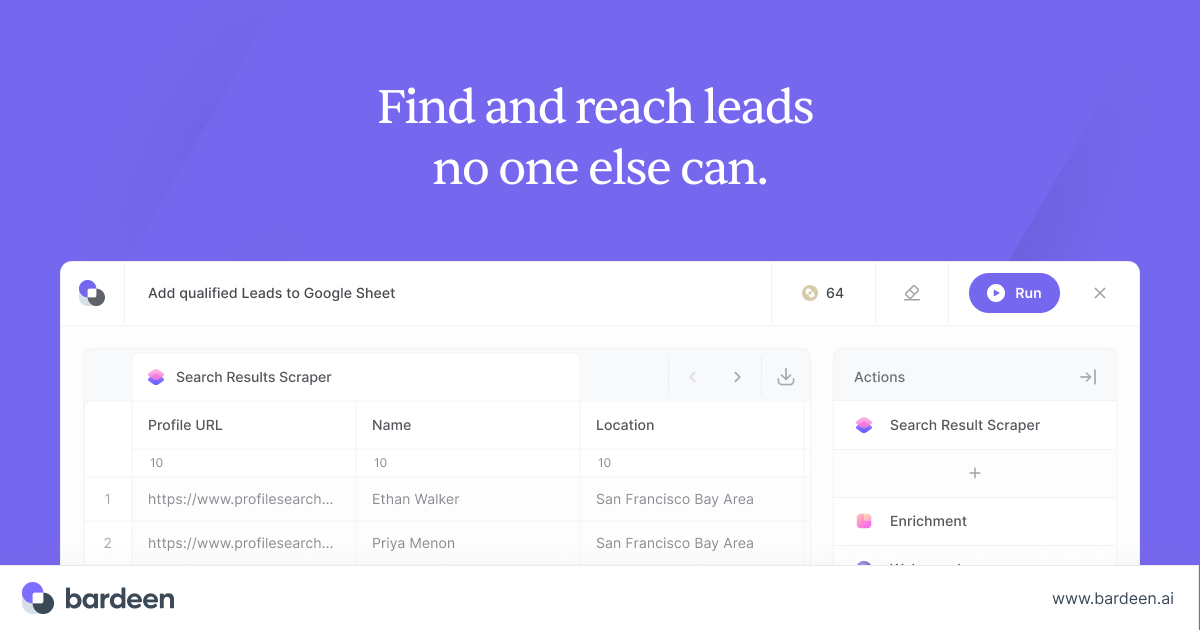
At its core, Bardeen is not a website you visit — it is an execution layer that installs into Chrome and Edge and operates on top of whatever page you have open. That architectural choice is the source of its unusual power. Rather than demanding an official API from every SaaS product, the engine reads the rendered DOM, navigates pagination, expands hidden panels, fills forms, clicks through multi-step wizards, and captures structured results into Google Sheets, Notion, Airtable, HubSpot, Salesforce, Slack, or a clipboard payload. Workflows are composed visually in a playbook builder, while the AI Magic Box lets a user describe an intent in plain language — “scrape every company on this page with its website, headcount, and founder” — and receive a working automation scaffold to refine. Because runs execute inside an authenticated browser session, the platform inherits the user's existing logins, permissions, and seat-based entitlements, which removes the single biggest blocker to automation in mid-market companies: security review and API provisioning. In practice this means a task that consumed twenty to sixty minutes of manual copy-paste and tab-switching collapses into a four-second deterministic run that can be repeated, scheduled, and audited. The compounding effect matters more than the individual time savings — once a workflow exists as a playbook, it becomes institutional infrastructure rather than tribal knowledge, and the company stops paying a human salary for a process a browser can execute flawlessly at any hour.
2. Bardeen AI Tools Hub
The AI tools surface is where Bardeen's prospecting and enrichment intelligence converges with browser automation. Instead of exporting a raw list and then manually researching each account, users run a single playbook that collects target records, then layers LLM-driven qualification on top: summarizing a company's positioning, classifying industry and buying signal, extracting named decision-makers, inferring tech stack hints, and writing a personalized opening line for outreach. The output is a spreadsheet that already reads like a researched pipeline rather than an unfiltered scrape. What distinguishes this from standalone enrichment vendors is the closed loop. Collect, enrich, score, segment, and route all happen in one pass, with each step visible and editable in the playbook canvas. Teams can therefore adjust scoring logic — for example, weighting hiring velocity or recent funding over headcount — and instantly re-run the pipeline against a fresh source page. For revenue operations leaders, that converts prospecting from a batch process with multi-day lag into a continuous, tunable system, and it removes the dependency on expensive per-credit enrichment contracts that punish experimentation.
3. Bardeen for Music & Talent Discovery
One of the more surprising vertical applications is talent discovery for labels, managers, A&R scouts, sync licensing teams, and independent curators. Emerging artists signal their trajectory across fragmented surfaces: streaming chart movements, playlist additions, short-form video velocity, follower growth curves, and independent press mentions. Manually cross-referencing those signals is exactly the kind of repetitive, multi-tab research work that automation handles best, and Bardeen packages it into repeatable scouting playbooks. The strategic value here is timing. By the time an artist appears on a mainstream chart, the commercial advantage has largely been arbitraged away by every other label with the same dashboard. Automated monitoring of smaller, faster-moving signals — a sudden playlist surge or a spike in short-form usage — gives scouts a defensible head start and produces structured, shareable candidate boards rather than scattered bookmarks and screenshots. For agencies and music-tech operators, the same mechanics apply to influencer and creator sourcing, where early identification of a rising voice translates directly into cheaper partnership rates and stronger campaign performance.
4. Task Mining Tools Intelligence Hub
Task mining is the discipline of capturing what people actually do on their desktops and browsers — the keystrokes, the app-switching, the copy-paste chains — and converting that evidence into candidates for automation. Bardeen's editorial hub for this category is a genuinely useful buyer's instrument, because it frames the technology in operational rather than marketing terms: what signals are captured, how privacy and consent are handled at scale, how discovered tasks are scored for automation potential, and where task mining ends and process mining begins. For an operations or continuous-improvement leader, the real takeaway is sequencing. Task mining is how you stop guessing which automations to build first, and a browser-native automation platform is where those discoveries get implemented once identified. Reading both categories side by side — discovery instrumentation and execution tooling — is what separates a credible automation roadmap from a wishlist of demo-friendly ideas that never survive production contact with real users, real legacy screens, and real exception handling.
5. Process Mining Tools Intelligence Hub
Where task mining observes individual desktop behaviour, process mining reconstructs the actual end-to-end flow of work from system event logs — revealing rework loops, hidden handoffs, and the gap between the documented procedure and the executed reality. Bardeen's comparative hub on the category is written for practitioners evaluating conformance checking, bottleneck detection, variant analysis, and the operational governance required to act on what the data reveals. The commercial argument is straightforward: in most organizations, a meaningful share of cycle time is consumed by steps no one documented and no one owns. Process mining exposes those steps with evidence rather than opinion, and that evidence is what unlocks budget for automation. Read alongside Bardeen's browser execution layer, the pairing becomes practical rather than academic — mining tells you which process is bleeding time, and playbooks let you remove the bleeding without waiting for a systems-integration project to be approved.
6. Enterprise AI Agent Platforms Directory
For larger buyers, the question is no longer whether AI agents work, but whether they can be governed. This directory evaluates the enterprise agent landscape through the criteria that actually determine a deployment's fate: identity and permission inheritance, audit logging and traceability, human-in-the-loop approval gates, deterministic versus probabilistic step boundaries, data residency, SSO, and the commercial support model behind the SLA. It is a serious piece of purchasing intelligence rather than a feature checklist. That governance framing matters because agentic automation fails in enterprises for organizational reasons far more often than technical ones — unclear ownership, unbounded scope, and the absence of an audit trail when something goes wrong. By making those dimensions explicit, the hub helps evaluation committees separate platforms that can be piloted by a single team from platforms that can be standardized across departments. The practical outcome is a shorter procurement cycle and a pilot that has a realistic path to production rather than an impressive demo that quietly dies in a sandbox.
7. AI Agents for Customer Support
Customer support is the most economically attractive automation frontier in most businesses, and also the most dangerous, because a badly designed agent degrades trust at exactly the moment a customer is already frustrated. This resource hub evaluates support-focused AI agents on the dimensions that separate defensible deployments from reputational risk: deflection accuracy, escalation logic, tone control, knowledge-base grounding, multilingual handling, and the ability to hand off cleanly to a human with full context attached. For support leaders, the practical framework is a tiered model — automate the high-volume, low-variance requests first, keep humans on anything emotionally or commercially sensitive, and instrument everything so that deflection rate is never optimized in isolation from satisfaction and resolution quality. Paired with browser-level automation, the same logic extends beyond the ticket queue into the surrounding operational work: pulling order details from a portal, updating an internal sheet, and routing follow-ups, all of which quietly consume hours that never appear on a support dashboard.
8. Bardeen Playbook Template Library
The template library is Bardeen's fastest route from curiosity to compounding value. Rather than building from an empty canvas, users start from pre-built playbooks that encode established patterns: scraping a directory into a spreadsheet, extracting LinkedIn profiles and roles into a CRM, monitoring competitor pricing pages on a schedule, collecting job postings for hiring-signal analysis, and pushing enriched records into outbound sequencing tools. Each template is a working reference implementation, which means it doubles as documentation for how the builder should be structured. Strategically, templates solve the adoption problem that kills most automation programs: the blank-canvas tax. A team member who has never touched a workflow builder can clone a template, adjust two or three parameters, and ship something useful in their first session — and that early win is what generates the appetite to build the harder, higher-value automations later. Over time, the best internal playbooks become de facto process documentation, and onboarding a new hire onto a team's operational routine becomes a matter of granting access rather than explaining a manual procedure.
9. Guides, Documentation & Implementation Playbooks
The guides and documentation layer is where Bardeen stops being a clever extension and becomes a trainable operational platform. Content covers building and editing playbooks, working with selectors and pagination on hostile pages, handling authentication and dynamic content, scheduling recurring runs, integrating with Google Sheets, Notion, Airtable, HubSpot, Salesforce and Slack, and debugging runs when a target site changes its markup — which, in web automation, is a certainty rather than an edge case. This is also where programmatic and advanced users find the connective tissue for deeper integration: webhook-style handoffs, structured output formats, and patterns for chaining automations so that the output of one playbook becomes the trigger for the next. For teams, the documentation functions as an internal enablement asset. Publishing a short runbook alongside each production playbook — what it does, what it depends on, who owns it, and how to fix it when a site changes — is the difference between an automation portfolio that compounds in value and a graveyard of scripts that broke quietly six months ago and nobody noticed.
🛠️ Built-in Smart Tools & Specialized Features in Bardeen.ai
Beyond core services, Bardeen.ai features a robust suite of specialized sub-tools engineered for granular operational speed:
Best Tools Directory
A curated, editorially structured index of the automation, mining, and AI-agent categories that matter to operations and revenue teams — useful as a landscape map before committing budget to any single vendor.
Blog & Automation Playbooks
Practical, example-driven content covering real scraping and workflow recipes, integration patterns, and applied AI-agent use cases, positioned as build-along inspiration rather than abstract thought leadership.
Plans & Quota Comparison
Transparent breakdown of execution credits, seat allocation, scheduling limits, and commercial usage rights — the first stop before scaling a pilot into a department-wide rollout.
App & Workspace FAQs
Answers the operational questions that surface in week one: installation, browser support, workspace access, permission behaviour, and what happens to running automations when a session ends.
Priority Support Desk
Direct ticketing channel for broken automations, selector drift on updated target sites, and billing or account questions — critical when a production playbook is on the critical path.
Enterprise Deployment Track
Evaluation pathway for larger organizations requiring governance, audit trails, permission inheritance, and a documented commercial support model before standardizing on agentic automation.
🎯 How Bardeen.ai Directly Empowers Your Workflow
Before reviewing subscription pricing, here is an operational breakdown of how Bardeen.ai scales productivity across key professional roles:
💼 For Founders, Executives & Business Leaders
Leadership teams use Bardeen to convert fragile, human-dependent processes into repeatable machine-run routines: competitor price monitoring, investor and partner list building, invoice and document harvesting from portals, and daily KPI roll-ups pushed automatically into Sheets or Slack. Because the browser extension inherits existing user permissions, there is no six-month IT integration project — a founder can prototype a revenue-ops workflow on Monday and have the whole team running it by Wednesday, cutting contractor spend on virtual assistants, data-entry freelancers, and one-off scraping scripts.
💻 For Growth Marketers & Acquisition Teams
Marketers use AI-assisted playbooks to compress an entire outbound research cycle into minutes: scrape a target account list, enrich each row with firmographic and social signals, de-duplicate against the CRM, score the list with an LLM prompt, and push the qualified subset into a sequencing tool. Campaign variants, competitor ad monitoring, influencer shortlisting, and content-repurposing pipelines become reusable templates instead of bespoke projects — meaning more tests shipped per week, faster learning loops, and dramatically lower cost per qualified lead.
👔 For Solo Consultants, Freelancers & Builders
Independent professionals get the single greatest asymmetric advantage of the decade: leverage without headcount. A consultant can deliver enterprise-grade market research, lead lists, and competitive intelligence in an afternoon rather than billing three weeks of manual work. The same playbook can be re-sold to multiple clients, re-run on a schedule, and shared as a deliverable — turning a one-off engagement into a repeatable productized service with margins that scale vertically instead of linearly.
🎨 For Creative Agencies & Production Studios
Agencies scale client output without operational burnout by industrializing the unglamorous parts: asset sourcing, metadata collection, publishing checks, reporting pulls, and approval routing. Client-facing reports that used to require a junior account manager's full day are assembled automatically from live sources, while creative energy is reserved for the work that actually commands premium fees. Standardized playbooks also mean a new hire becomes productive on client workflows in hours, not weeks, protecting both margin and quality consistency.
💳 Official Pricing Plans & Subscription Tiers in Bardeen.ai
Bardeen.ai employs transparent, predictable pricing tiers. Here is the verified breakdown of official plans:
| Plan / Tier | Pricing | Quota / Limits | Key Inclusions | Best Suited For |
|---|---|---|---|---|
| Free / Trial Tier | $0 | Limited credits | Core features access | Beginners & evaluation |
| Standard Plan (Most Popular) | $15 - $29 / mo | Generous recurring quota | Full HD & commercial license, no watermark | Solo creators & consultants |
| Enterprise Tier | Custom Pricing | Unlimited + API | Dedicated support & SLA | Agencies & scaling teams |
⚖️ Head-to-Head Comparison: Why Choose Bardeen.ai Over Traditional Alternatives?
The following comparison outlines measurable productivity returns when deploying Bardeen.ai versus manual work and legacy alternatives:
| Benchmark Dimension | With Bardeen.ai | Traditional / Competitors | Net ROI & Value |
|---|---|---|---|
| Turnaround Speed | Sub-15 minutes | Days or weeks of manual effort | 95% time reduction |
| Production Cost | Flat affordable subscription | Thousands in contractor fees | Over 90% budget savings |
| Learning Curve | Intuitive no-code canvas | Steep technical skill curve | Instant empowerment for all |
🔗 Official Directory & Direct Functional Links for Bardeen.ai
For verified direct access to every genuine functional tool and official resource within the platform, here is the curated directory:
🛠️ Official Functional Links & Core Products Directory for Bardeen.ai
Curated direct functional links extracted from the official navigation and footer, organized in contextual descriptive items:
⚡ Direct Access & Official Pricing:
📚 Official Documentation & Support:
🌐 Global & Regional Market Support (Languages, Payments & Compliance)
Regional adaptability, language processing fidelity, and friction-free payment acceptance are critical for international teams. Here is the operational compliance evaluation:
🌐 Multilingual Processing & RTL Localization
The platform features robust cross-language comprehension, seamlessly processing diverse international character sets and RTL scripts for truly global workflows.
💳 Frictionless Global Billing & Payment Methods
Accepts major credit and debit cards (Visa, MasterCard, Amex), Apple Pay, and PayPal, with clear VAT-compliant invoicing for international teams.
❓ Frequently Asked Questions (FAQ)
Direct, comprehensive answers to the most critical technical and commercial inquiries regarding the platform: